From identifiers to sensors, from management systems to standards: the challenge is figuring out how to combine them to make a product’s history traceable throughout the supply chain.
As soon as you start talking about digital traceability, the conversation quickly fills with tools. Some have installed sensors. Others have introduced a new management system. Still others have added a QR code to the packaging. And, of course, some are considering blockchain.
So, which technology is the wisest choice?
But that question almost always comes too soon. Let’s take a step back: first, we need to understand what the system is for.
Do you need to precisely identify a product or a batch? Exchange information with other organizations? Reconstruct the product’s history?
Only when the function is clear can you choose the right tool.
That’s why, in this article, we’re sorting through the digital traceability toolkit: not to determine which technology is absolutely the best, but to understand what each one does and how they can connect with one another.
What technologies are needed for a digital traceability system?
No single technology can, on its own, build a digital traceability system.
Below is a summary of the functions of the main technologies discussed today.
| Function | Tools / Technologies |
| Identify | Barcode, QR code, RFID, NFC |
| Capture | Scanners, operators, sensors, and IoT devices |
| Manage | ERP, MES, WMS, QMS |
| Exchange | APIs, EDI, connectors, middleware |
| Describe | GS1 standards, EPCIS |
| Connect | Traceability and supply chain governance platforms |
| Make verifiable | Blockchain and distributed ledgers |
1. Identify: barcodes, QR codes, RFID, and NFC
How do we identify the product?
Before collecting information about a product, we must be able to identify it.
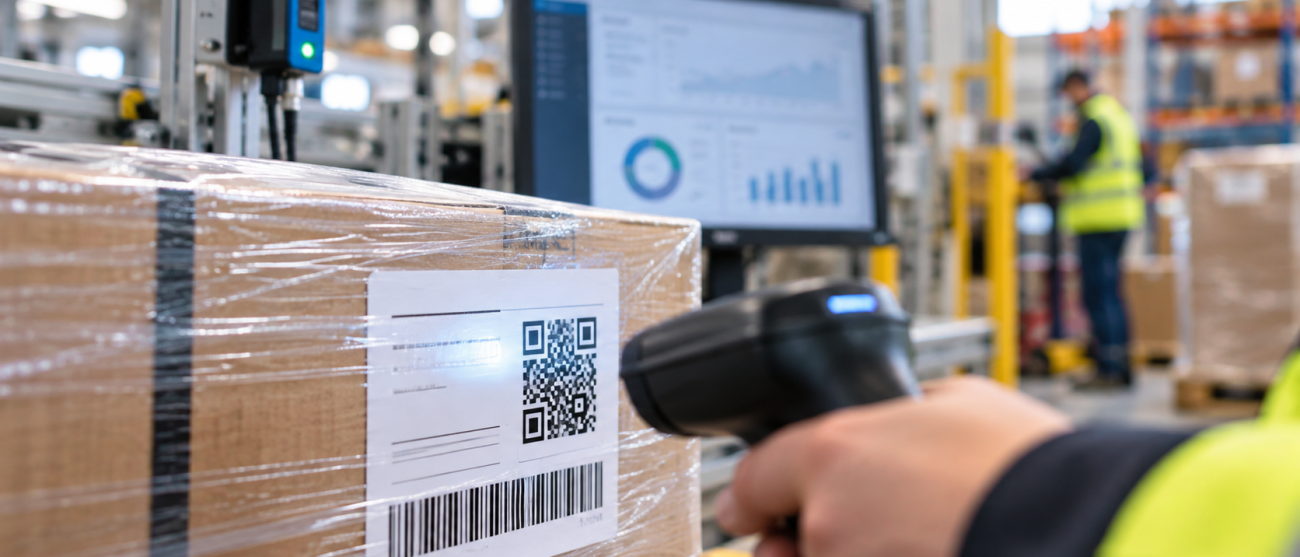
Barcodes, QR codes, RFID, and NFC are data carriers: media through which an identifier or other data can be read by a machine or device.
They allow devices and applications to recognize a product, a batch, a pallet, a container, a location, or an entity in the supply chain. Some can also convey information such as batch number, expiration date, or serial number.
But the code remains merely a gateway. Behind it, there must be up-to-date data, a system to store it, access rules, and links that consistently match the correct product.
2. Collecting Data: IoT Sensors, Scanners, Devices, and Operators
How do we collect information about what happens to the product?
Once the product or batch has been identified, data must be collected on what happens during the process. The information can be entered by an operator, read by a scanner, or automatically detected from the physical world via sensors. In the latter case, the Internet of Things comes into play.
The Internet of Things, or IoT, refers to connected sensors and devices capable of detecting and transmitting data such as temperature, humidity, or location. It is particularly useful when the frequency of measurements, the need for continuous monitoring, or the risk of error make manual recording impractical.
A sensor, however, first and foremost produces a measurement. To transform it into information, one must know what was measured, where and when, with which device, and in relation to which product, batch, or process stage.
So the sensor collects the measurement. For that measurement to become traceability information, the system must preserve its context and link it to the correct event.
3. Managing Data: ERP, MES, WMS, and QMS in Traceability
Where do we manage this information?
Most companies already have software that manages information relevant to traceability.
In 2025, 46.45% of companies in the European Union used ERP applications, and in the manufacturing sector, that figure reached 57.62%. ERP systems are typically designed to integrate various business functions, such as purchasing, sales, planning, administration, orders, and so on.
Alongside ERP, there may be more specialized systems:
- MES primarily manages production execution;
- WMS manages the warehouse, inventory, and material handling;
- QMS supports quality controls, nonconformities, and quality-related activities;
- vertical management systems oversee processes specific to a particular industry or organization.
These categories do not always have rigid boundaries; in fact, many software products incorporate modules that span multiple areas.
The question to ask, therefore, is: which part of the process does the software manage, and what level of detail can it track?
In fact, a system may perfectly manage an SKU-level item, but not be configured to store lot numbers, expiration dates, serial numbers, or the relationship between inputs and outputs.
A study published by GS1 US in 2026 shows, for example, that information such as lot, batch, expiration date, and serial number is not yet captured consistently. The report also highlights that systems and workflows designed solely around product identification may require manual tasks when handling more granular data.
So having an ERP or a WMS doesn’t mean you lack traceability. But it also doesn’t mean that the product’s history can already be traced through all the stages and organizations involved.
4. Data Exchange: APIs, EDI, Connectors, and Middleware
How do we transfer information between systems and organizations?
Data may exist in the right systems but still remain siloed. That’s why a digital traceability system must also include tools that allow applications to exchange information.
Among the most common are:
- APIs, which allow two applications to request or send data according to defined rules;
- EDI, used to transmit structured business documents between organizations;
- connectors, developed to link specific systems;
- middleware or integration platforms, which manage transformations, routing, and synchronization.
These tools allow data to flow from one application to another, but they do not all work the same way: two systems may correctly exchange a field called “batch” but assign different formats, scopes, or levels of detail to it.
This is not just a theoretical problem. In a survey conducted by Foods Connected and Censuswide in 2024, 69% of companies that digitally collected data from suppliers still reported the presence of data silos.
This figure does not prove that digital data collection is useless. However, it shows that we can digitize the flow of data without also making the relationships between systems, departments, and responsibilities transparent. And this is where shared standards and languages become necessary: identifiers, attributes, events, units of measure, statuses, and update criteria must be described consistently.
Connectivity enables data to flow.
Interoperability allows systems to understand and use that data consistently.
5. Describing Data: GS1 and EPCIS Standards
How do we ensure that different parties assign the same meaning to the data?
A standard defines common rules through which products, entities, locations, and events can be identified and described.
In the GS1 system, for example:
- the GTIN identifies commercial units;
- the GLN identifies entities and locations;
- EPCIS enables the representation and sharing of visibility events throughout the supply chain.
At Wiseside, for example, we have chosen to use GS1/EPCIS standards, when applicable to the project, to represent and share supply chain events.
EPCIS allows us to describe what has happened to a product or other item using certain common dimensions: what, when, where, why, who, and how.
The advantage is clear: reducing ambiguity between systems and organizations. If a manufacturer, carrier, warehouse, and customer describe a shipment, receipt, or transformation using incompatible criteria, each step requires translation and realignment.
A standard establishes a common language. It is then up to the software to implement it correctly and for organizations to agree on which events and information should be shared.
6. Connecting: Traceability Platforms and Supply Chain Governance
How do we link events and responsibilities along the supply chain?
ERP, MES, WMS, and QMS systems typically operate within the scope of the organization or function they are designed to manage.
A supply chain platform performs a different task.
It can be used to connect:
- information from multiple systems;
- events generated by different companies;
- documents and records;
- products, batches, and logistics units;
- distributed roles and responsibilities;
- requests, reports, and follow-up activities.
Its purpose is to enhance what business systems already do by establishing a level of connectivity and shared understanding across processes that span multiple departments or organizations.
This is precisely where our iChain comes in: a collaborative cloud/IoT platform designed to collect, organize, and link supply chain data and events, based on the project scope and planned integrations. The goal is to make the relationships between events, records, and responsibilities more transparent.
However, it is important to remember that a supply chain platform does not automatically generate reliable data. Reliability depends on the quality of the sources, the consistency of identifiers, the participation of stakeholders, and the clarity of processes.
7. Making Records Verifiable: Blockchain and Distributed Ledgers
How do we make records verifiable?
Blockchain is often directly associated with the integrity and verifiability of records.
Certainly, a distributed ledger can be useful when multiple parties need to share records and none of them should be able to modify them unilaterally without leaving a trace.
It can help strengthen:
- the integrity of records;
- the verifiability of changes;
- sharing among parties with differing interests;
- the automation of certain rules through smart contracts.
However, it does not guarantee that the data was correct at the time it was entered. This is a crucial distinction: making a record difficult to alter is not the same as certifying the quality of its origin.
A review published in 2025 on 60 studies related to European agri-food supply chains found that blockchain is the most studied technology and appears in over 40% of the works analyzed, often alongside IoT, RFID, and QR codes. In the general agri-food category, however, only 3% of the studies concerned full-scale implementations, while 66% described applications that were still at the conceptual stage.
This data suggests a cautious interpretation: some technologies attract attention more quickly than they can be stably integrated into processes.
A blockchain may therefore make sense within a specific governance framework, but it should not be chosen solely because it is associated, in the public imagination, with transparency.
Technology matters. So does the design.
QR codes, sensors, ERP systems, standards, platforms, and blockchains can perform important functions. Their presence, however, does not automatically guarantee a traceable supply chain.
A code may be read by a scanner but not interpreted by the system. An ERP system may effectively manage the company’s internal operations without communicating with partners. A blockchain may preserve information that was incorrect at its source without alteration.
That is why the choice of tools must start with the process design: what information is needed, where it originates, what it must be linked to, who should be able to use it, and what activity or decision it must support.
This is where traceability becomes digital: when each tool performs a clear function and helps keep the product’s history transparent.
The design question, therefore, remains:
Which connection needs to become more traceable, and which tool can help us build it?
Main Sources
- Eurostat, E-business integration, 2025 data on the adoption of ERP, CRM, and BI in European companies.
- GS1, official documentation on the EPCIS standard.
- VDC Research and GS1 US, *Advancing Intelligent Data Capture in Modern Logistics Operations*, a study conducted in 2025 and published in 2026.
- Bekkouche and de-Magistris, “Digitalization in the European Agri-Food Supply Chain,” Frontiers in Blockchain, 2025.
- Foods Connected and Censuswide, research on the digitization of food safety, quality, and traceability, March 2024.


CEO of Wiseside, I have been working on supply chain digitalization for over 10 years, with one goal: making complex supply chains more transparent and manageable by connecting data, processes, and people.