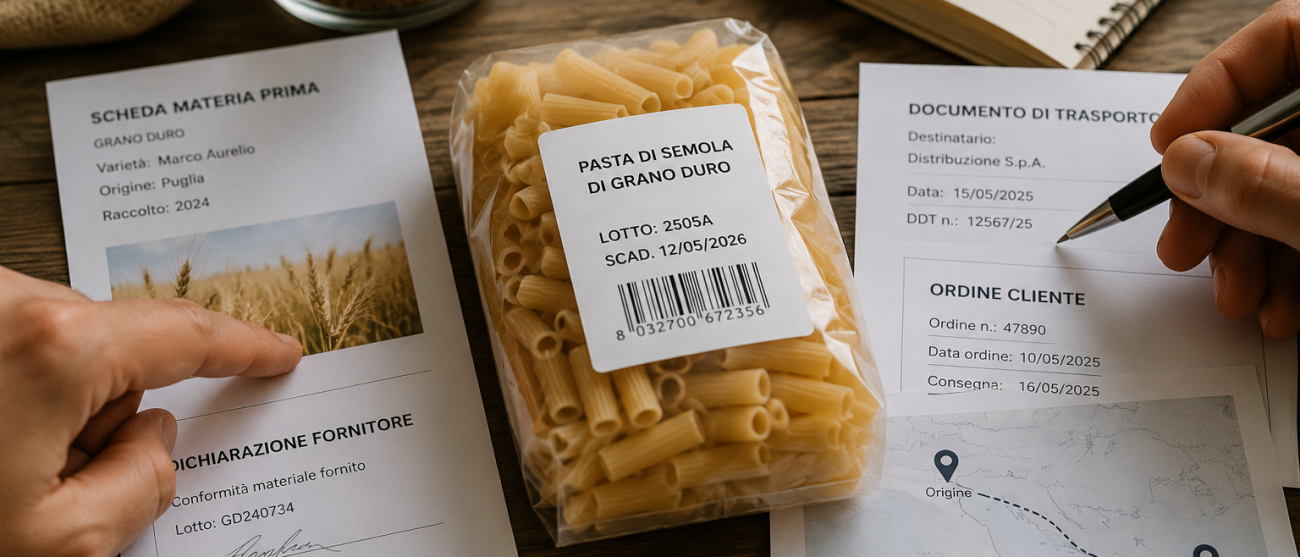
Two complementary aspects of the same information system. And two questions that a supply chain must be able to answer without having to start from scratch.
A customer reports a fault with a product that has already been delivered.
From that moment, two investigations begin.
The first looks back: Where did the problem originate?
The second looks ahead: Where have the potentially affected products ended up?
There is one batch. There are two questions.
And it is precisely in situations like this that the difference between traceability and tracking becomes a real issue of data, timing and accountability.
Because when something doesn’t add up, it’s not enough to know that the information exists. You have to be able to find it, link it together and use it quickly enough to make a decision.
And if doing so requires three systems, four phone calls and the memory of the right person, the problem is not merely tracing a batch.
It is about making clear what has happened to it.
The data exists. The answer, not yet
In most companies, there is no shortage of information: it is recorded in management systems, production documents, quality sheets, logistics systems, supplier files, emails or logs compiled by operators.
The problem arises when that information has to be used together to answer certain questions. And that is when a traceability system is put to the test.
- Which raw materials were used?
- Which suppliers did they come from?
- Which production processes did they go through?
- Which finished products were produced?
- Where were they stored and to whom were they delivered?
The answers can be found at various points along the supply chain; they exist, but they do not automatically tell the product’s story.
Meanwhile, the market won’t wait
It is not merely an internal matter.
Pressure is coming from across the entire supply chain: from consumers, who want to better understand what they are buying, and from retailers, who must manage risks, controls and their responsibilities towards the market.
According to the TEHA Group’s 2025 report, for more than 1 in 5 consumers, traceability is a deciding factor. For companies in the modern retail sector, it is also one of the key requirements placed on supply chain partners.
The ability to track and trace, therefore, is not merely a compliance requirement: it is becoming an increasingly important factor in supply chain relationships, market access and the ability to demonstrate what has happened.
What is the difference between traceability and tracking?
Clarifying this difference helps us understand what information needs to be collected and, above all, which links must remain traceable over time.
To put this into practice, simply start with a question: in which direction am I reading the data?
What is traceability?
Traceability follows the product from source to end.
It helps us to know:
- where a batch has been sent;
- which stages it has passed through;
- which parties have handled it along the way.
The practical question is: Where have I sent this product?
What is tracking?
Tracking works in the opposite direction: from downstream to upstream.
It serves to reconstruct a product’s history:
- what materials were used;
- where they came from;
- what steps led to its production.
The practical question is: Where does this product come from?
This is not merely a difference in terminology.
It is functional.
Two directions, two questions, two aspects of the same journey.
An anomaly does not follow just one direction
In the event of an anomaly, a recall or non-compliance, traceability and tracking must therefore be able to work together.
Let’s return to the initial report.
A customer reports the presence of an anomaly in a food product belonging to a specific batch.
The first step is to trace its history:
- identifying the production run in which it was manufactured;
- verify the raw materials and semi-finished products used;
- identify the relevant batches of origin;
- trace suppliers, production processes and quality controls;
- check for any anomalies recorded during the process.
This upstream analysis enables us to understand where the problem may have originated.
But tracing the cause only solves half the problem.
Once, for example, a potentially non-compliant raw material has been identified, it is necessary to understand:
- in which other products it has been used;
- which finished batches may be affected;
- what quantities are still in stock;
- which have been dispatched;
- to which customers or delivery points;
- on which dates.
At this point, the analysis shifts direction and moves downstream.
Understanding where the problem originates helps to identify its cause. Understanding how far it has spread helps to contain its effects.
In other words, traceability helps to reconstruct the origin and history of the problem; tracking enables us to identify its possible destinations and thus the scope within which to take action.
What does a traceability and tracking system need to function?
Distinguishing between the two directions therefore helps us understand which information links must remain traceable over time.
In practice, reading the data in both directions means preserving certain fundamental links:
- between raw materials, semi-finished products and finished products;
- between the inputs and outputs of processing operations;
- between events, locations and stages of the process;
- between activities, responsible persons and available records.
It is not necessary for every piece of information to be entered at the same time. However, it is essential that it can be traced back to the same flow without having to manually interpret codes, versions and relationships each time.
This is where the difference lies between simply recording data and constructing a usable narrative.
In the first case, we know that the information has been collected.
In the second, we also know how to retrieve it, link it and interpret it when needed.
If these links are unclear:
- the information has to be searched for repeatedly;
- it takes longer;
- decisions become more complex;
- the scope of the problem risks expanding out of an abundance of caution.
Not because the data doesn’t exist.
But because it has not yet been organised in such a way as to provide the right answers collectively.
What does Regulation (EC) No 178/2002 stipulate regarding traceability?
In the food sector, the key reference is Article 18 of Regulation No 178/2002, known as the General Food Law.
In practical terms, every business must be able to identify the parties from whom it has received food, feed, animals intended for food production or substances used in products.
It must also have systems and procedures in place to identify the businesses to which it has supplied its products and make this information available to the competent authorities when requested. This is the principle commonly summarised as ‘one step back, one step forward’.
In short: how does one implement ‘one step back, one step forward’?
The requirement sets out what information must be retrievable upstream and downstream, but does not prescribe a single way of organising it. Businesses may adopt different systems, provided they are able to produce the required information.
And this is where the practical work begins.
Because information may be formally present and, at the same time:
- difficult to retrieve;
- not aligned with other records;
- associated with inconsistent codes;
- spread across multiple parties;
- available only through one person’s knowledge;
- too slow to reconstruct given the severity of the anomaly.
The quality of the system therefore does not depend solely on the presence of a record.
It depends on the ability to turn it into a reliable response when it is needed to support an audit, a recall or a decision.
5 questions to determine whether a traceability system really works
1. Starting with a finished product, how quickly can we trace back to the inputs?
Not just the category of raw material, but the batches used, the suppliers, the processing stages and the relevant checks.
2. Starting with a raw material, can we easily identify all the products into which it has been incorporated?
This is the most concrete evidence of the relationship between inputs and outputs.
Without this link, the scope of a problem tends to be widened as a precaution.
3. Can we quickly trace the destinations of a batch?
Customers, warehouses, delivery points, quantities and dates must be identifiable without having to rely on an ad hoc search.
4. Is the information already linked?
Or does someone have to piece it all together each time from management systems, spreadsheets, documents, emails and phone calls?
5. Is it clear who is responsible for each piece of data?
Who records it, when must they do so, who checks it, and who must make it available when an anomaly arises?
These questions do not merely assess a system’s compliance. They assess its ability to support the work.
It is not enough simply to keep a record. You must be able to read it
Traceability and tracking depend on the quality of the data and, above all, on the links established between events, batches, activities and responsibilities.
This is why the quality of a system is not only apparent when everything goes according to plan.
It is particularly evident when something is amiss and we need to understand, quickly, where the problem originates and how far it may have spread.
The crucial question, then, becomes: how long does our traceability system take to produce a reliable answer, in both directions, when it is really needed?
Main sources
- GS1 Italy, Fundamentals of traceability systems in the agri-food sector.
- TEHA Group for FederDistribuzione, The Leading Role of Modern Retail and Private Labels in the Sustainable Transition of the Agri-Food Supply Chain, Position Paper, 2025.
- European Parliament and Council of the European Union, Regulation (EC) No 178/2002, in particular Article 3(15) and Article 18 on traceability in the food sector.


CEO of Wiseside, I have been working on supply chain digitalization for over 10 years, with one goal: making complex supply chains more transparent and manageable by connecting data, processes, and people.